Mould prevention in Townsville's wet season
Why North Queensland homes grow mould from December to April, how to stop it before it starts, and how to remove it safely without bleaching the problem invisible.
Anyone who has lived through a Townsville wet season knows the smell. You open a wardrobe in February and it’s there — that flat, earthy note that means something is growing on the back wall behind your good shirts.
Mould is not a sign you’re a bad housekeeper. It’s a sign you live somewhere with 80% relative humidity for months at a time. But it is manageable, and the difference between a house that gets through the wet cleanly and one that doesn’t comes down to a handful of habits set up before the season starts.
Why it happens here specifically
Mould needs three things: spores, a surface with something organic on it, and moisture. Spores are everywhere and always will be. The organic material is ordinary house dust, skin cells and cooking residue. So the only variable you actually control is moisture.
In a Townsville wet season, ambient humidity regularly sits above 70% for weeks. Mould germinates on a surface when the moisture content at that surface passes roughly that threshold — and critically, it does not need liquid water. A cool wall behind a wardrobe in a humid room is enough, because the air right at that surface is colder, and colder air holds less moisture, so the relative humidity against the wall is far higher than in the middle of the room.
That’s why mould shows up in the same places every year:
- The south and east-facing external walls that get the least sun.
- Behind and under furniture pushed flat against those walls.
- Inside built-in wardrobes with no ventilation.
- Bathroom ceilings, especially where the exhaust fan vents into the roof space rather than outside.
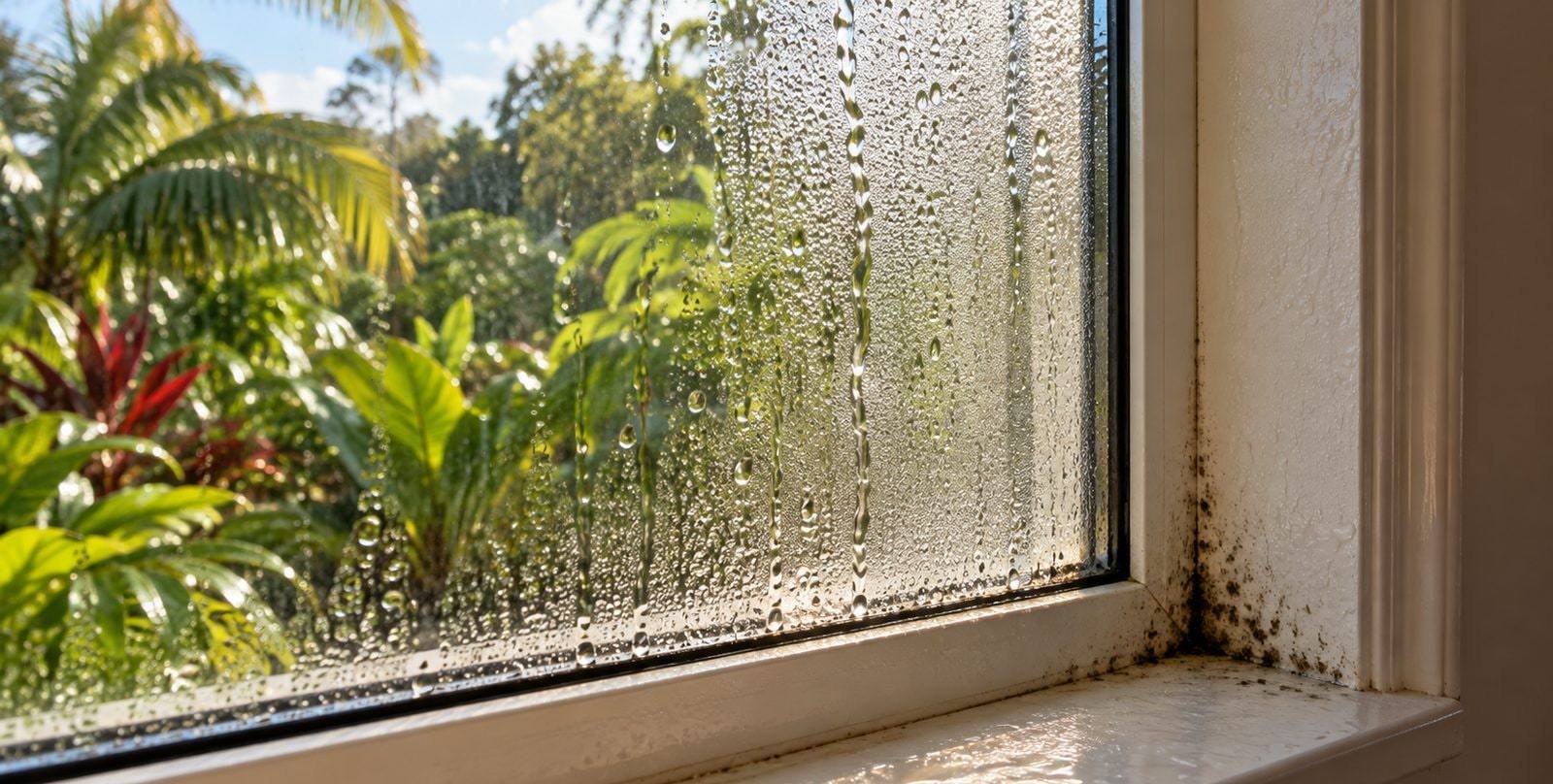
- Window reveals and sills, where condensation collects overnight.
- Leather, canvas and natural fibres — bags, shoes, camera gear, guitar cases.
- Inside the washing machine door seal.
The prevention that actually works
Run the air conditioning as a dehumidifier
This is the single most effective thing you can do, and most people use it wrong. Cooling on a low temperature for a short burst does less than running dry mode for a longer period at a moderate setpoint. Dry mode deliberately runs the compressor to condense moisture out of the air without over-chilling the room.
Running dry mode for a few hours a day through the worst of the wet — even in rooms you’re not occupying — costs far less than replacing a wardrobe of clothes.
Move furniture off the walls
Fifty millimetres of air gap behind a wardrobe or bedhead on an external wall does a genuinely surprising amount. It lets the wall surface stay closer to room temperature instead of forming a cold, still pocket.
Get air moving
Ceiling fans on low, all day, in rooms you’re not in. Still air is the enemy. Moving air keeps the boundary layer at wall surfaces from saturating.
Fix the bathroom exhaust
Two checks worth doing before December:
- Does it vent outside? Many older Townsville homes have exhaust fans that simply dump into the roof cavity. That relocates your bathroom’s moisture into your ceiling.
- Does it actually pull? Hold a tissue to the grille. If it doesn’t stick, the fan is dead or the duct is blocked.
Run it during the shower and for 20 minutes after — a timer switch is a cheap fix that removes the discipline problem.
Ventilate wardrobes
Louvred doors, or simply leaving doors ajar. Moisture absorbers in the corner help in a small enclosed space. Never store anything even slightly damp — a towel or a pair of gym shoes in a closed wardrobe will seed the whole thing.
Deal with clothes drying
Drying clothes indoors during the wet dumps litres of water into your house. Use a vented dryer, a covered outdoor line, or at minimum run the room’s air conditioning while clothes are drying.
Keep gutters and drainage clear
Overflowing gutters push water into wall cavities and under eaves. Clear them before the season, not during it.
Removing mould properly
Don’t reach for bleach first
Household bleach on a porous surface — plasterboard, grout, timber, render — bleaches the pigment out of the mould so it becomes invisible, while the hyphae, the root structure underneath, survive. It looks clean and comes back in a fortnight, often worse.
What to use instead
For hard, non-porous surfaces, ordinary detergent and warm water with physical agitation removes mould effectively. Physically removing it is the goal; killing it in place is not enough, because dead spores still trigger allergic responses.
For porous surfaces, white vinegar is the usual recommendation from health authorities: apply undiluted, leave for an hour, scrub, wipe, dry thoroughly. Vinegar penetrates rather than just bleaching the surface.
Whatever you use, the drying step is the actual treatment. A surface left damp after cleaning is a surface being reseeded.
Protect yourself
Disturbing mould aerosolises spores. For anything beyond a small patch:
- A P2 or N95 mask — a surgical mask does nothing here.
- Gloves and eye protection.
- Open the windows and get cross-ventilation going.
- Bag disposable cloths immediately rather than rinsing them in the sink.
Anyone with asthma, an allergy, or a compromised immune system should not do this work.
When to call someone
Get professional help if:
- The affected area is larger than about one square metre.
- The mould keeps returning in the same spot after proper treatment — that usually means a leak or a building fault, not a cleaning problem.
- It’s inside the air conditioning system or ductwork.
- It’s behind or inside wall cavities.
- Someone in the house has a respiratory condition.
Recurring mould in one location is a building diagnosis job, not a cleaning job. A cleaner who tells you they can permanently fix mould caused by a leaking shower recess is selling you a repeat visit.
A pre-wet-season checklist
Worth doing in November:
- Clear gutters and downpipes
- Test and clean every exhaust fan; confirm it vents outside
- Service the air conditioning and wash the filters
- Pull furniture off external walls
- Empty, wipe and dry out wardrobes; check stored leather and canvas
- Reseal any failed silicone in showers and around windows
- Check window and door seals for gaps
- Wash and fully dry curtains and blinds
- Clean the washing machine seal and leave the door open between loads
Renting?
If mould is caused by a building defect — a roof leak, failed flashing, a shower that leaks into the wall, or an exhaust fan that vents into the ceiling — that is a maintenance issue for the lessor, not a cleaning failure by you. Report it in writing, with photos and dates, as soon as you see it. A written record from January is worth a great deal at your exit inspection in July. Our bond clean checklist covers how that plays into getting your bond back.
Need help getting on top of it? We do one-off deep cleans and scheduled wet-season maintenance across Townsville. Request a callback and we’ll come and look at the problem areas before we quote.